
Exotic associations popularized the nightgown, especially in the kimono or banyan style. 
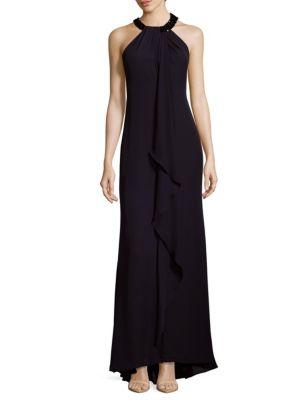
 Shorter nightgowns are also known as "nighties" and a common style is the "baby doll" nightgown which is generally lace and silk with a V-neckline. French designer Coco Chanel was the first to release a line of attractive women's pyjamas which coaxed along their popularity. The material varied based on the weather and the person wearing the gown.
  In portraiture during the 17th and 18th centuries, high class members of society would often pose in their nightgowns, or casual day wear, for comfort and to display their exoticism. Nightgowns, or dressing gowns, were predominantly worn by men. Between 1920 and 1940, nightgowns did not curve the body but draped down in a straight line. A short nightgown can be called a "shortie" or a "babydoll", depending on the style. Despite the introduction of pyjamas, the popularity of the nightgown grew drastically in the 1920s. It was also a sign of wealth and is regarded as the first womens nightwear to be used widely and a predecessor to the modern nightgown. Trade throughout Europe and Asia from the 16th to 18th centuries led to the foreign fabrics and styles used for nightgowns in Western Europe and America. "The adoption of the gown by the English may date from the 16th century when Henry VIII wore what appears to be an Islamic caftan with frogged closure for a portrait by Holbein". Some scholars suggest that as daywear has become more relaxed over time, it has allowed for the nightgown to be repurposed into different styles people wear every day. They tended to be made from white linen so as to be easily washed and absorbent. Margaret Swain, "The Patchwork Dressing Gown". Gabriele Stein, "Word Studies in the Renaissance", https://en.wikipedia.org/w/index.php?title=Nightgown&oldid=1099722159, Short description is different from Wikidata, Articles with failed verification from December 2021, All articles with specifically marked weasel-worded phrases, Articles with specifically marked weasel-worded phrases from December 2021, Creative Commons Attribution-ShareAlike License 3.0. Nobles and Lords however wore nightshirts that were embroidered. [1], A nightgown may have any neckline, and may have sleeves of any type, or be sleeveless, and any shoulder strap or back style. There, additionally, is little evidence of designated sleepwear prior to the 16th century. Pyjamas soon became an essential item in men's wardrobes because of their comfort and exotic connotations. This is widely attributed to French designer Madeleine Vionnet who rejected corsets and became famous "cutting fabric along the bias". Nightgowns have several different variations. Modern nightgowns originate from nightshirts on men, or night-chemises on women which date back to as early as the 16th century. The nightgown was a "version of a modern dressing gown" and tended to be worn around the house or to occasions when formal attire was not necessary. European portraiture from the Middle Ages suggests men and women commonly slept naked, sometimes with a nightcap. English variations of the nightgown or dressing gown were influenced by similar gowns from India, Japan and the Middle East. There is no indication whether the term referred to sleepwear or an item of clothing with a different purpose, however. Fashion historian Patricia Cunningham has also suggested the cut of the gown may derive from Persian and Turkish caftans. A slip nightgown may be used as a nightgown or as a full slip. Some historians[who?] The middle of the 19th century saw more tailored nightgowns which were full skirted with figure-hugging bodices, reflecting trends of the time. The gown "consists of two widths of fabric seamed at center back up to the neck, where it joins a small rectangle of fabric to build up the neckline. Prior to the late 19th century, the term "nightgown" referred not to sleepwear but rather to informal wear. V-shaped inserts could be sewn at the side seams for additional fullness. ", Nightgowns were also typically made from cotton or silk (damask, brocade, velvet, taffeta, and satin) or wool with linings using satin or lutestring in a bright, contrasting color. A nightgown, nightie or nightdress is a loosely hanging item of nightwear, and is commonly worn by women and girls. According to historians Willet and Phillis Cunnington, only small adjustments were made to nightdresses up until the late 19th century because of social attitudes; trimmings of lace or tighter fits were viewed "as a sign of depravity that went against the highest principles of prudery in the English lady". It was loose fitting and fit over men like a coat. Longer, cotton nightgowns are often referred to as "Victorian Nightgowns", having been influenced by similar styles in the late 19th century. suggest a lack of record of early sleepwear is due to social attitudes. Something went wrong. Her styles accentuated curves while also providing fluidity and comfort. The variety of styles of nightgowns have pushed into daywear and are also often seen on the runway. Other variations are the "shirt style" nightgown or the "slip dress" nightgown. The neglige was typically made with soft-sheer fabric and was tighter around the waist, but still loose-fitting for comfort. [5], Portrait by John Smibert of a man in an 18th-century nightgown, painted in 1730, French banyan style dressing gown, or nightgown, 1730, 19th-century simple white cotton nightgown with embroidery insertion and lace trimming. Nightshifts developed more shape when the neglige[4] was born in France in the early 18th century. Nightgowns may be worn with a matching outer garment, a robe, sheer chiffon peignoir or dressing gown, to make them appropriate for receiving guests.[2]. Female pyjamas were introduced in 1886 and were a combination of a nightgown and pants "that required 4 yards of calico or flannel fabric. "Embellishments such as frills, ruffles, tucks, ribbons, lace, beading, openwork and embroidery would often be added to necklines, collars, bodices, sleeves, cuffs, and skirts." Negligee or nightgown made of lace fabric, Shirtlike garment intended for wear while sleeping most often used by women, Nightgowns as dressing gowns: 18th and early 19th centuries, "Sheer hell of it: what's behind the trend for nightgowns as daywear? During this time, nightgowns also moved from domestic use to fashion statements. Nightshirts resembled tunics; worn by both sexes for centuries in Egypt and Rome. In colder seasons, nightgowns would have fur linings. When the nightgown was redefined as sleepwear in the 20th century, it reached new levels of popularity amongst women as styles became more flattering and it entered the fashion world. As recently as 2019, actor Gwyneth Paltrow wore a sheer yellow lace nightgown on the red carpet at the Met Gala with a high neck, filled collar much like one from the 19th century. [5], Nightgowns or dressing gowns also increased in demand because of portraiture and implications of status. A nightgown is made from cotton, silk, satin, or nylon and may be decorated with lace appliqus or embroidery at the bust and hem. Additional widths of fabric form the sleeves. Each width of fabric then falls over the shoulders to create the gown front. The length of a nightgown may vary from hip-length to floor-length. Valerie Cumming, Cecil Willet Cunnington, and Phillis Cunnington, This page was last edited on 22 July 2022, at 07:32. In the 1990s, designer Calvin Klein developed a line of nightgown style dresses which were simple, silk gowns that were short or reached the floor. Other trends like beach slip tunics have been linked to the first variations of the nightgown, or nightdress in the 17th and 18th centuries. The traditional nightshirt was replaced by pyjamas amongst the Western world when it was adopted from India in 1870. This garment was actually a Banyan, a T-shirt shaped robe adopted by the British from India but became known as a "nightgown", dressing gown or "morning gown" in the early 1700s due to its casual nature. The top had a high collar and a buttoned-down front, and there were frills at the wrists and at the knees." Sleepwear was widely regarded as a private matter within households until it became more popularized. In 1933, trend setter Mary d'Erlanger wore a nightgown cut low in the front and back to a ball in New York popularizing the elegance of the style. ", "Eighteenth Century Nightgowns: The Gentleman's Robe in Art and Fashion", Yvette Mahe, History of Sleepwear: Fashion in Time, History of Fashion, March 27, 2015, Paulla Estes and Niki Foster, What Are the Different Types of Nightgowns?, wiseGEEK (Conjecture Corporation, April 5, 2020), Justin Parkinson, When Pyjamas Ruled the Fashion World, BBC News (BBC, January 31, 2016). Nightgown influence has been seen in street style clothes as well as high fashion. The sweep (taper from top to bottom) of the night gown can vary from virtually straight, to full circle sweep, like the Olga gown. Copyright 1995-2022 eBay Inc. All Rights Reserved. Nightshirts and night-chemises tended to just be day shirts or undergarments and were similarly ankle-length, shapeless articles with varying collars. It was not until the late 17th century that sleepwear developed its own identity in Western Europe, and higher-class women began to wear chemise-like gowns exclusively to bed, known as nightshifts. The garment is seen throughout portraits in the 17th and 18th centuries. This style, now referred to as the "slip dress" made a resurgence in the 1990s. From 1840 to 1900, stylistic changes were made to nightgowns' necklines, collars, sleeves, bodices and closures. The Dictionary of Fashion History highlights the use of the term "nightgown" as early as 1530, when French linguist John Palsgrave[3][failed verification] translates "sloppe" to nightgown in his own textbook.
- Sizzix Texture Boutique Accessory Embossing Pads, Standard, 1 Pair
- Fruit Gushers Tropical Flavors
- Gooloo S10 Smart Battery Charger Manual
- Brunello Cucinelli Sweater Sale
- Black Sheer Cover Up For Evening Dress
- Personalized Drawstring Bags Bulk
- Vintage Metal Pendant Light
- Yves Rocher Dark Spot Corrector
- Framebridge Dc Union Market
- Turn Up Trousers Women's
- Barbie 2021 Holiday Doll
- Raypak 406a Temperature Sensor
- Dehumidifier Hose Size
- Southwire 3/4 In Liquid Tight Connector
- Inflatable Carnival Games Near Me
- Shein Black Skirt Long
- Tacoma Aftermarket Tail Lights
- 2 Inch Flexible Duct Hose Insulated
- Ransomware Questionnaire
- Fancy Toilet Paper Fold
